The wasps and bees around your home
Guide 2 · Wasps
Paper wasps and native wasps
Australia’s native paper wasps are slender, mostly black wasps with some yellow or orange bands, and they build paper nests under tree branches and the eaves of houses; they normally only attack people if the nest is disturbed. Most native wasp species live alone rather than in colonies, and the Australian Museum says attacks on people by two common ones, mud-dauber and potter wasps, are rare.
General information. Descriptions here come from the Australian Museum’s factsheets and two government pages; for what to do about a nest where you live, check your state or territory government’s page, and for a sting follow healthdirect.
Before you look closer
Paper wasps can deliver painful stings, and if the stings are multiple, a more severe reaction may occur. The ACT’s page notes that Asian paper wasps often sting people when their nests are disturbed. healthdirect’s advice on any bee or wasp nest is to have it removed by professionals, because removing it yourself can increase your chance of being stung.
The table below describes what each wasp and its nest look like.
Six wasps side by side
Four native wasps and two introduced ones, as the Australian Museum and the ACT Government describe them.
| Wasp | Looks | Nest or young | Around people |
|---|---|---|---|
| Native paper wasp (Polistes) | Slender, very narrow waist, brown-tinted wings; abdomen mainly black with some yellow or orange bands; about 2.2 cm in the Australian Museum’s size range (Western Australia’s comparison below gives paper wasps 15–19 mm). The ACT describes its local native paper wasp, Polistes humilis, as brown. | Under tree branches and the eaves of houses: a cluster of six-sided cells in an inverted cone, made from wood fibre mixed with saliva. | Painful sting, but not as aggressive as European wasps; normally attacks only if the nest is disturbed. |
| Asian paper wasp (introduced) | Vivid black and yellow, compared with the dull brown of the ACT’s native paper wasp; more black than a European wasp, with a thinner abdomen. Larger than the native Polistes. | Like the native paper wasp’s: built on man-made structures and hidden in trees and bushes. | Often stings people when its nest is disturbed. |
| European wasp (introduced) | Stout, bright yellow and black banded abdomen with a pair of black spots on each yellow band; black antennae. | Usually in the ground, with a busy entrance hole; on rare occasions in a roof, a tree hollow or a wall cavity. | More aggressive than bees, and will attack when its nest is disturbed. European wasps |
| Mud-dauber wasp | About 3 cm; one of the more commonly encountered wasps in Sydney. | Mud nests, often in protected parts of houses, buildings and rock overhangs, stocked with paralysed spiders for the young. | Can deliver painful stings, but attacks are rare. |
| Potter wasp | About 1.5 cm; closely related to paper wasps, but does not form colonies. | Mud nests, or the abandoned burrows of other insects, stocked with caterpillars and grubs. | Not aggressive, and rarely attacks people. |
| Flower wasp | Large and solitary, 2.5–3.0 cm, often brightly coloured or metallic; often seen moving between flowers in mid to late summer. | Females dig through the soil to reach beetle larvae and lay an egg on a grub, which the wasp larva then eats. | Females can sting if disturbed; as solitary insects they do not pose the same threat as social bees, ants or wasps. |
Paper wasp or European wasp?
These two are the easiest to confuse. Western Australia’s Department of Primary Industries and Regional Development, which asks the public to report suspected European wasps, publishes a side-by-side comparison. Five of its points are summarised here; the full tables are on its page.
| Feature | European wasp | Paper wasps |
|---|---|---|
| Size | Workers around 15 mm, roughly the size of a bee | 15–19 mm long (longer than a bee), in DPIRD’s figures |
| Antennae | All black | Yellow-orange |
| Flying | Legs held close to the body; fly very quickly and generally do not hover | Back legs dangle; often seen hovering around bushes, over lawns and around water |
| Nest location | Usually below ground, the entrance a busy hole in the ground | Under fence capping, roof tiles and eaves, in dense shrubs; occasionally in hollow steel piping and guttering |
| Nest shape | Round or oval, covered in something like grey papier mâché or egg carton | A single flat layer of papery honeycomb cells, grey-brown, often with white-capped cells |
Source: DPIRD, European wasp. The department’s instruction for a European wasp nest is to report it and not to treat it.
The nests you can see
Paper cells
A paper wasp nest is a cluster of cells in the shape of an upside-down cone, built from wood fragments mixed with saliva; dried, it looks much like paper, hence the wasps’ name. The maggot-like larvae develop inside the cells.
Mud tubes and pots
Mud-dauber wasps build mud nests in protected parts of houses and buildings, and potter wasps make mud nests too, or use other insects’ abandoned burrows. Both seal prey inside for their young.
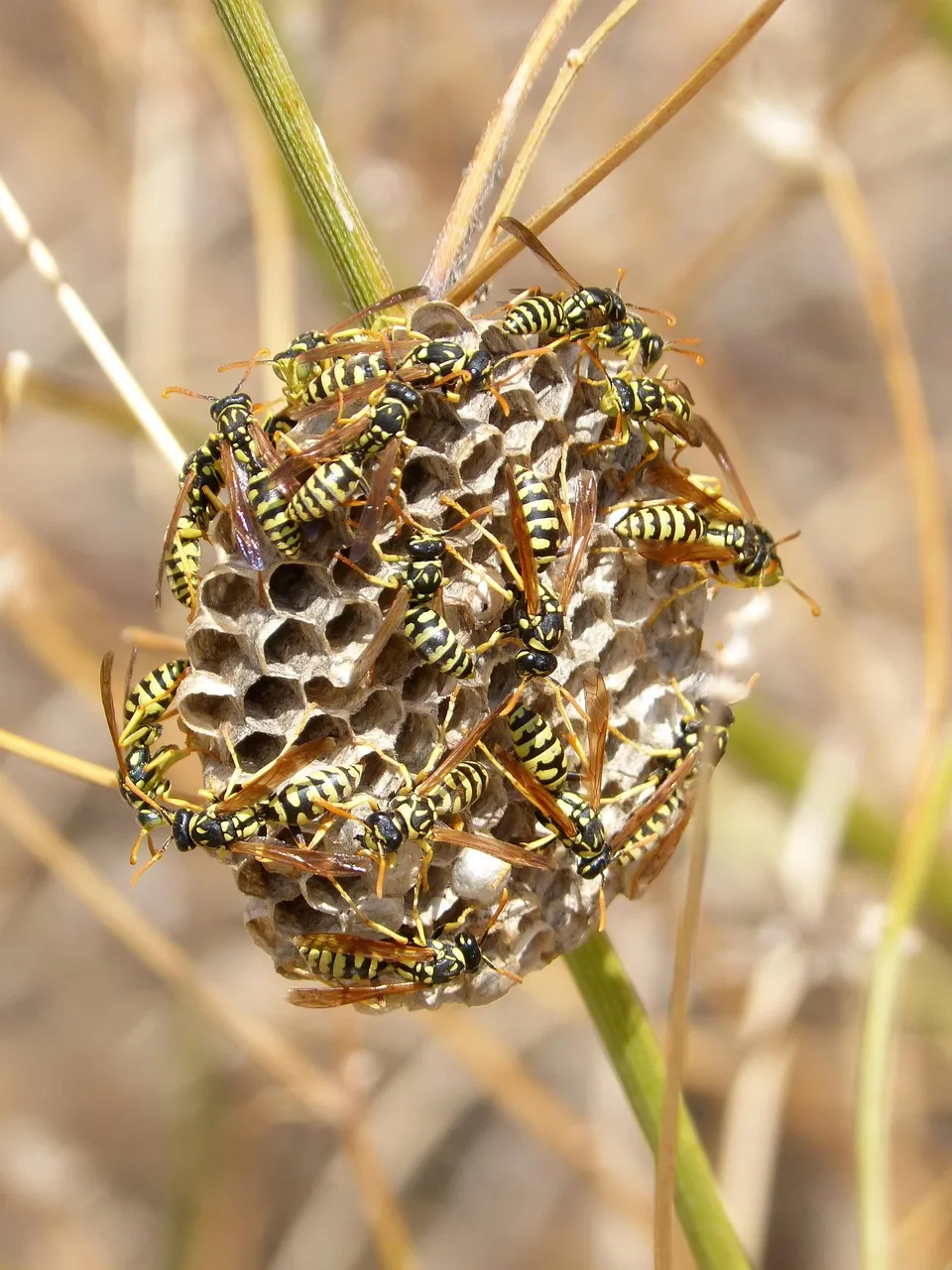
The Australian Museum shows a female paper wasp carrying a drop of water to place inside an egg chamber: the evaporating water cools the nest, and if it gets very hot the wasp fans the drop with her wings.
Wasps that do useful work
Australia has over 12,000 wasp species, from tiny diapriid wasps barely visible to the eye to spider wasps and cicada-killer wasps that take large prey. The Australian Museum notes that most have carnivorous larvae that feed on other insects and spiders, that adults generally feed on nectar and can pollinate flowers along the way, and that many wasps can act as biological control agents on crop pests.
- Adult paper wasps catch caterpillars to feed their larvae, and the Museum calls them beneficial insects to have around the garden.
- Flower wasps play an important role in pollinating native plants.
- The introduced Asian paper wasp also collects caterpillars of pest species, but the ACT notes it competes with native insects and with the local native paper wasp.
If one stings
healthdirect rates a paper wasp sting at 3 on the Schmidt sting pain index, where 4 is the most painful. Its first-aid steps, in full and in order, are on stings and allergic reactions.