The wasps and bees around your home
Guide 3 · Bees
Bee swarms
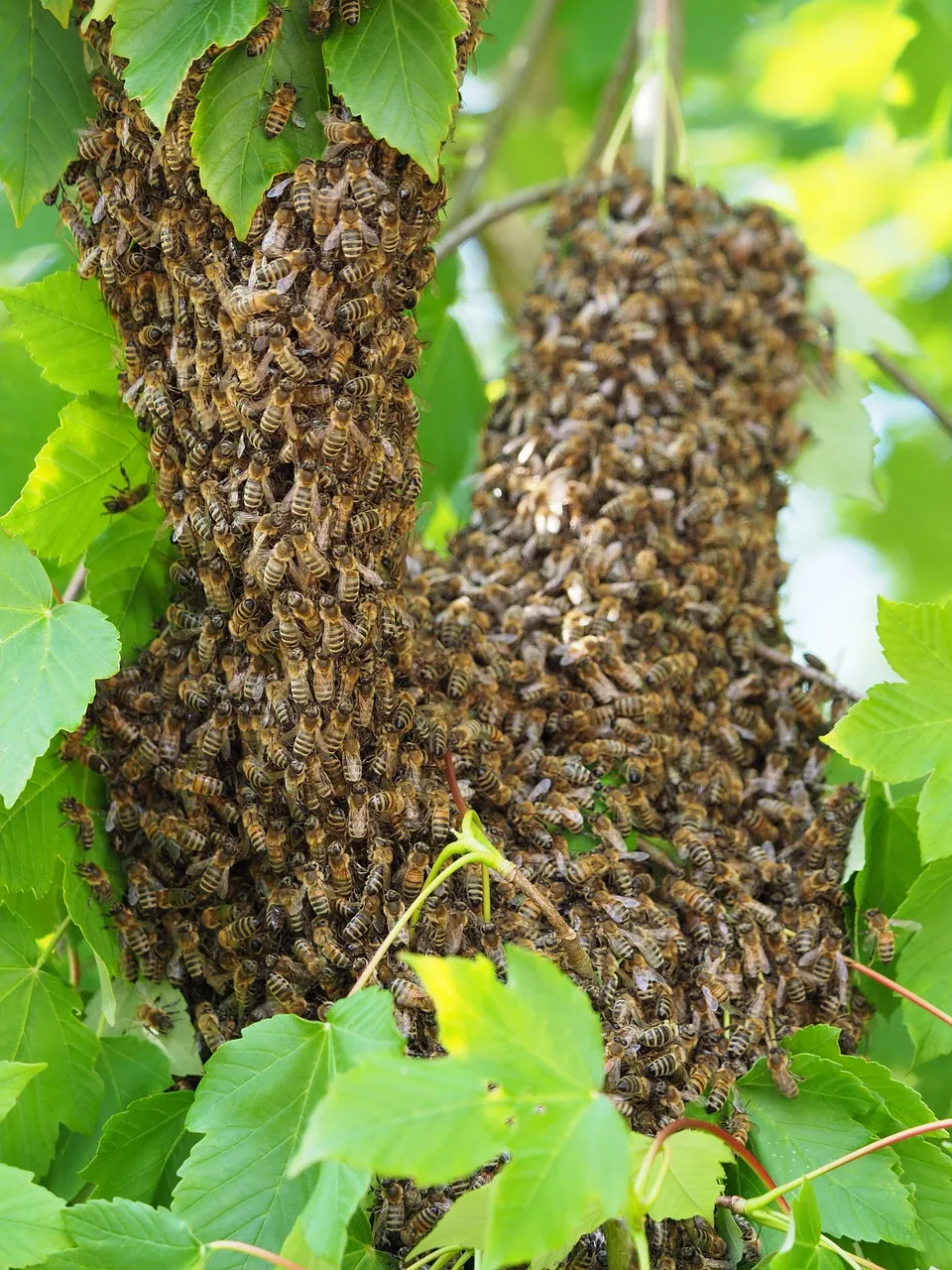
A bee swarm is, in Business Queensland’s words, “a round or oval mass of bees seeking a place to start a new nest under the direction of a queen”, and “swarming bees are usually placid and unlikely to sting when left undisturbed”. The official advice is to leave a swarm alone, keep out of its flight path, and let a swarm collector or a local beekeepers’ association deal with it.
General information. The swarm advice here is from the ACT and Queensland governments and the Australian Museum, each named; check your own state or territory’s page. For a sting, follow healthdirect.
What you are looking at
The ACT Government describes a swarm settling in a cluster around the queen bee while worker bees search for a suitable place to create their new hive. Swarms are usually calm once settled.
Left alone, the ACT says, a swarm will move on naturally in a few days. A swarm is not yet a hive; the next section shows the difference.
When swarms happen
In the ACT, bees generally swarm between August and December. Queensland’s beekeeping page says swarms naturally occur in spring to early summer.
- Jan
- Feb
- Mar
- Apr
- May
- Jun
- Jul
- Aug
- Sep
- Oct
- Nov
- Dec
Highlighted: August to December, the ACT Government’s swarming months.
What to do
Don’t approach it
The Australian Museum’s advice: “If you find a swarm of bees, do not approach it.” healthdirect notes that honeybees normally only sting in defence.
Leave it alone and keep out of the flight path
The ACT says to leave a swarm alone and stay out of its flight path: it will move on by itself within a few days.
If it needs collecting, call a swarm collector
For a swarm on private property, the ACT says to call a swarm collector, and points to the Amateur Beekeepers Australia website to find the closest one. The Australian Museum suggests contacting your local beekeepers’ association.
A swarm or a hive?
A cluster around the queen, resting while workers search for a new home; usually calm, and gone in a few days if left alone.
Where the bees have settled. Beehives are usually found in tree hollows, in wall and roof cavities of houses and buildings, and in other sheltered places that protect them from predators and weather.
healthdirect’s advice for bee and wasp nests is to have them removed by professionals, because removing them yourself can increase your chance of being stung. In the ACT, a nuisance beehive on ACT Government land can be reported through the government’s European Wasp, Ants or Bees Report form.
Bees or wasps?
The ACT’s page sets out the difference. Bees are a dull yellow or golden-brown through to black, with black stripes around the body but no black dot. European wasps are bright yellow and black with bright yellow legs, black dots between the stripes down each side of the abdomen, and longer, thicker antennae than bees.
The Australian Museum adds that some flies imitate honey bees very well, but a fly has just one pair of wings and no sting. If it is wasps, see European wasps.
If the swarm came from your hive
Queensland’s page for beekeepers says: “You should take responsibility for a bee swarm that has come from one of your hives and whenever possible capture it as soon as it has formed into a cluster.” Collecting swarms to fill spare hive boxes reduces the risk of nuisance bees setting up a colony in nearby buildings and trees, and a local beekeeping club can advise on handling swarming bees.
Swarms also matter for varroa mite, a parasite of honey bees:
- Western Australia’s department lists swarms and drifting bees among the ways varroa spreads.
- Queensland asks beekeepers to limit the movement of hives, swarms and nucs, and to avoid bringing swarms into their apiaries until they have been treated and a negative wash has been done.
- The national outbreak page’s advice includes: “Practice swarm control to reduce feral honey bee sources of mite reinfestation and spread.”
More in varroa mite and beekeepers.
If a bee stings
A honey bee’s sting is barbed and stays in the skin, and healthdirect says to scrape it out as quickly as you can with the edge of a fingernail or a credit card, rather than pulling it. Its full steps, and when to call for help, are on stings and allergic reactions.
If you think someone is having anaphylaxis, healthdirect says to give an adrenaline autoinjector if there is one, and ring triple zero (000) for an ambulance.